
2026-10-28 · Javier Soto
How Local Humidity Affects Drying Times in Fontana Water Damage Jobs
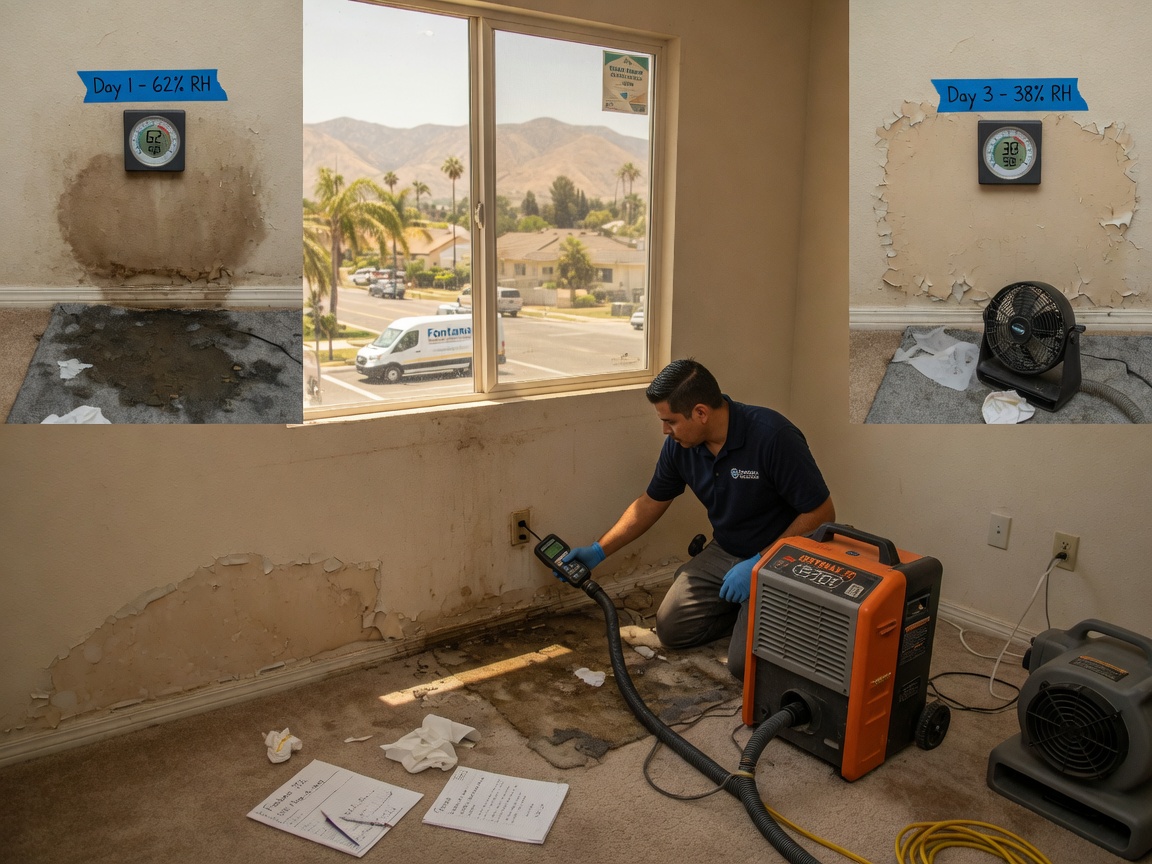
In Fontana's hot-summer Mediterranean climate, elevated humidity during winter months can extend drying times for water damage jobs by requiring extra days of dehumidification compared to the drier summer conditions typical in Downtown Fontana and South Fontana.
Fontana Climate Patterns and Humidity Cycles
Fontana sits in San Bernardino County with a hot-summer Mediterranean climate that produces dry summers and occasional winter rains. These rains raise relative humidity, especially in older housing stock around Downtown Fontana and North Fontana where single-story homes with slab foundations trap moisture longer. Operators running jobs near Fontana City Hall or the Auto Club Speedway notice that morning fog and marine layer influence from the west can keep indoor humidity above outdoor levels for 48 hours after extraction. This forces crews to monitor conditions more closely than in nearby drier stretches of Rancho Cucamonga. Equipment like air movers must run longer cycles to pull trapped moisture from drywall and subfloors before mold sets in.
How Humidity Changes Equipment Runtime
Higher humidity reduces the efficiency of standard drying setups because moisture-laden air resists evaporation from saturated materials. In South Fontana neighborhoods with 1960s-era homes, crews often add portable dehumidifiers earlier in the process when outdoor readings climb after rain events that also affect Rialto and San Bernardino. Structural drying protocols call for daily moisture meter checks on affected walls and floors to track progress. Without these adjustments, timelines stretch because fans alone cannot overcome the slower vapor pressure differential created by local humidity spikes. Jobs in North Fontana near newer developments still require the same vigilance since even modern builds sit on soil that retains water from seasonal storms.
Practical Adjustments for Local Water Damage Jobs
Crews working water damage restoration projects in Fontana adapt by staging equipment based on real-time humidity readings rather than fixed schedules. After extraction on a burst pipe job, technicians place sensors in multiple rooms to detect pockets where humidity lingers near concrete slabs common in the area. This approach prevents callbacks when moisture migrates into adjacent spaces. Homeowners in areas bordering San Bernardino benefit from early intervention that accounts for the county's variable winter weather patterns. Structural drying protocols here emphasize continuous monitoring over several days until readings stabilize across all affected surfaces.
Monitoring and Verification Steps
Daily documentation of temperature and humidity readings guides decisions on when to scale back equipment. In older Downtown Fontana properties, hidden moisture in lath-and-plaster walls demands targeted drying that accounts for slower release rates during humid periods. Technicians cross-check with moisture meters on drywall to confirm progress before recommending any reconstruction. This hands-on method proves especially useful on jobs that extend into nearby Rialto or San Bernardino where similar climate effects appear. Using moisture meters on drywall in Fontana restoration projects provides further detail on the tools that support these checks.
Coordination with Nearby Service Areas
Restoration timelines in Fontana often overlap with work in Rancho Cucamonga and San Bernardino because humidity systems move across the region. Crews coordinate extraction and drying phases to avoid bottlenecks when multiple calls arrive after the same storm. This regional awareness helps maintain consistent results whether the job sits near the Auto Club Speedway or in South Fontana residential tracts. Water damage restoration teams apply the same humidity-adjusted methods across these corridors to keep projects on track without unnecessary delays.