
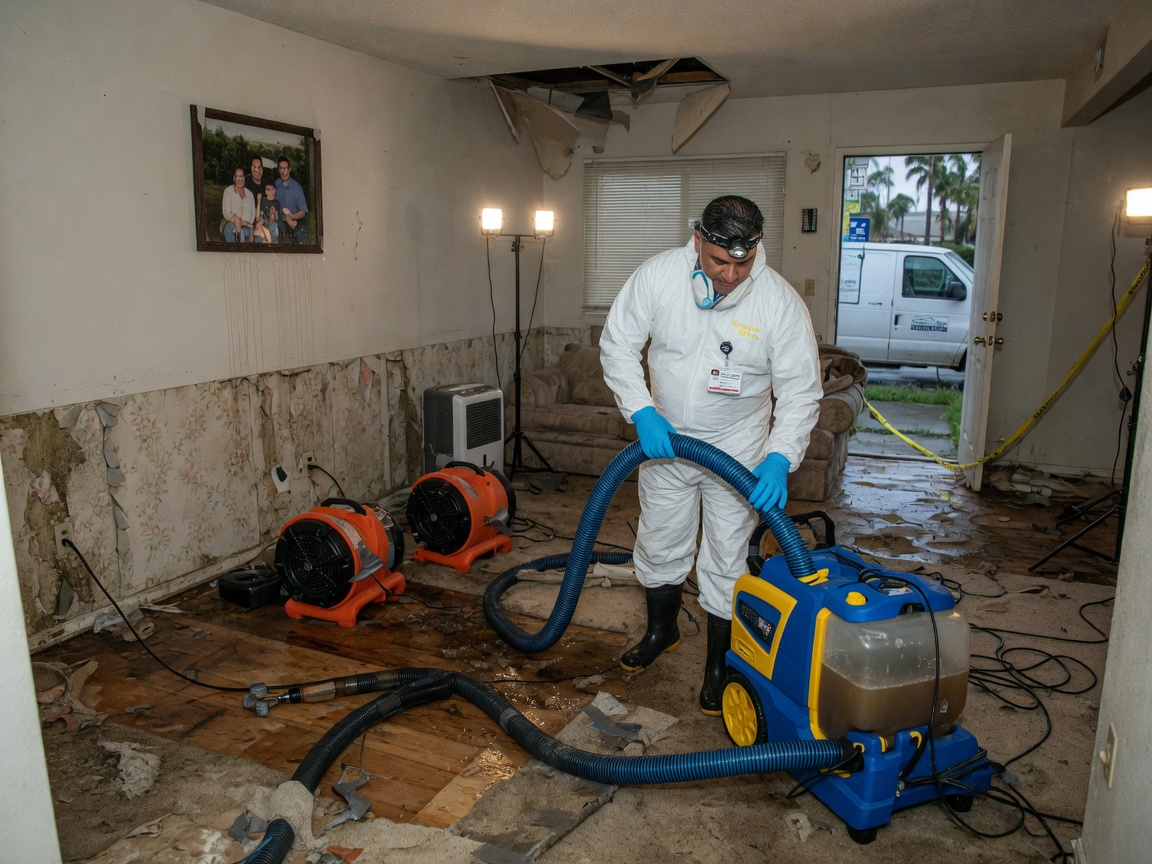
Fontana’s hot-summer Mediterranean climate drives heavy air-conditioning use from late spring through fall, and condensation lines often clog in homes built before the 1990s in North Fontana and South Fontana. When those lines back up, water migrates into attic insulation and drywall, creating hidden pockets that standard fans miss. Older single-story tract homes near Auto Club Speedway frequently have original galvanized supply lines that corrode from the inside, releasing water under pressure once temperatures spike. Crews must pull ceilings in multiple rooms and use moisture meters on stucco walls because the dense plaster traps moisture against framing for weeks.
San Bernardino County building codes require permits for any structural drying that affects load-bearing walls, so jobs near Fontana City Hall or in Downtown Fontana move slower once drywall is opened. Rialto and Rancho Cucamonga homes sit on slightly higher ground but still see sewer backups after rare winter storms because the clay-heavy soil expands and cracks older clay sewer laterals. Restoration teams carry extra containment barriers for these jobs to keep construction dust from migrating into living spaces while negative-air machines run for five to seven days.
Flash flooding along the dry washes that cross South Fontana can push water under slab foundations within hours. Technicians cut strategic weep holes along the perimeter and inject air under the slab rather than relying on surface drying alone. This step prevents recurring musty odors that homeowners notice every summer when the heat returns. All work is performed with the understanding that many neighborhoods still have original 1960s–1980s electrical panels that cannot safely support high-amperage drying equipment without upgrades.
Technician insight
In Fontana, the thing that catches most people out with Water Damage Restoration is how quickly attic condensation from summer AC use soaks insulation in 1970s–1980s South Fontana tract homes; once it reaches the drywall, homeowners often wait too long and the job turns from drying into full ceiling replacement.
Attic Condensation Leak in South Fontana
A homeowner in South Fontana noticed brown stains on bedroom ceilings after a week of 100-degree days. We found a clogged AC condensate line that had saturated blown-in insulation and two layers of drywall. Extraction and targeted drying prevented mold growth; we replaced only the affected ceiling sections and restored the original texture to match the rest of the house.
Water Damage Restoration Services We Offer
✓Emergency Water Extraction
Rapid removal of standing water from living spaces, garages, and crawl spaces using truck-mounted pumps sized for Fontana tract homes.
✓Structural Drying and Dehumidification
Industrial drying of walls, floors, and ceilings with moisture mapping to protect older stucco and drywall common in North Fontana.
✓Pipe Burst Restoration
Full demolition, drying, and rebuild after galvanized or copper line failures that occur during summer heat spikes.
✓Ceiling and Attic Leak Repair
Targeted removal of wet insulation and drywall after air-conditioner or roof leaks that spread across multiple rooms.
✓Sewage and Category 3 Cleanup
Safe extraction and sanitization of contaminated water from sewer backups that affect South Fontana homes on older laterals.
Water Damage Restoration Cost in Fontana, CA
| Service | Typical Range | What Affects It |
|---|---|---|
| Water Extraction | $600–$1,800 | Higher when multiple rooms or crawl spaces are involved |
| Drying Equipment Rental | $400–$1,200 | Based on number of days required for older stucco homes |
| Ceiling Or Wall Restoration | $1,200–$3,500 | Depends on linear footage and finish matching |
| Category 3 Sewage Cleanup | $2,000–$4,500 | Includes containment and sanitization |
Ranges are typical for Fontana, CA and confirmed with an exact written quote before any work starts.
How it works
- 1
On-Site Assessment
Technician arrives within the hour, maps moisture with meters, and identifies affected materials in the specific home construction type.
- 2
Water Removal
Standing water is extracted and contents are moved to prevent secondary damage before drying begins.
- 3
Drying And Monitoring
Equipment is placed and checked daily until moisture readings meet industry standards for the San Bernardino County climate.
- 4
Restoration And Repairs
Damaged materials are replaced and finishes matched to the original construction in Downtown or South Fontana homes.
Pricing
Pricing varies by water volume, affected square footage, and whether structural repairs are required.