
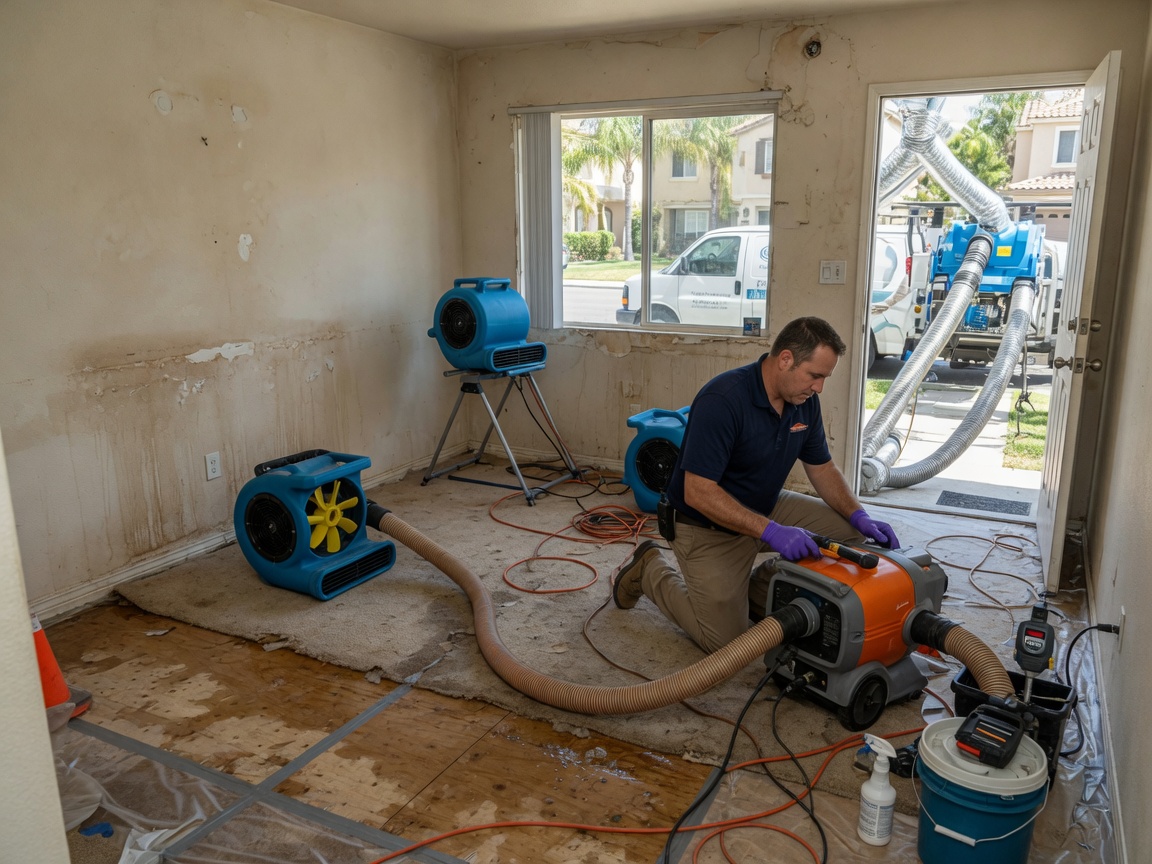
In Fontana’s hot-summer Mediterranean climate, sudden winter rains and occasional flash flooding from the San Bernardino foothills drive water into older stucco and slab-on-grade homes common in South Fontana and around Auto Club Speedway. Structural drying must address moisture trapped behind plaster and under tile because daytime heat can push vapor deeper into framing before it evaporates. Technicians use moisture meters and thermal imaging to map saturation without opening every wall, then set up air movers and dehumidifiers sized for the square footage and local humidity spikes.
North Fontana neighborhoods built in the 1980s and 1990s often have enclosed attics and limited crawl spaces that trap humidity after leaks near Fontana City Hall or along Sierra Avenue corridors. Drying crews isolate affected zones with containment barriers to keep moisture from migrating into unaffected rooms, especially important when nearby Rancho Cucamonga or Rialto properties share walls or rooflines. Equipment run times are adjusted daily because afternoon temperatures above 95 degrees can overload standard dehumidifiers if not vented properly.
San Bernardino County building practices favor concrete foundations and stucco exteriors that hold water against wood sill plates for weeks. Technicians monitor relative humidity and material moisture content until readings fall below 12 percent before recommending drywall or flooring replacement. Skipping this step frequently leads to mold growth that later requires additional remediation when summer heat returns.
After any water event, crews document drying progress with daily logs that homeowners can share with insurance carriers serving the Fontana area. This record shows when hidden pockets of moisture were located and removed, preventing disputes over whether damage was fully addressed before reconstruction begins.
Technician insight
In Fontana the thing that catches most people out with structural drying is how fast summer heat drives moisture deeper into stucco walls and under slabs before anyone notices. Older South Fontana homes with single-layer plaster over wood lath hold water against sill plates for weeks, and skipping daily meter checks lets hidden pockets stay wet long enough to trigger mold when the next monsoon rain hits.
South Fontana Slab Leak
A kitchen leak in a 1990s South Fontana tract home had soaked the concrete slab and migrated under adjacent tile. Moisture mapping showed saturation extending three feet beyond visible damage. Crews placed floor-level drying mats and ran dehumidifiers for six days until slab readings dropped below 12 percent, allowing the homeowner to proceed with tile replacement without further mold risk.
Structural Drying Services We Offer
✓Moisture Mapping and Detection
Thermal imaging and pinless meters locate hidden water behind stucco and under slabs in South Fontana homes without unnecessary demolition.
✓Air Mover and Dehumidifier Placement
Strategic equipment layout pulls moisture from framing and concrete in North Fontana properties while accounting for high daytime temperatures.
✓Crawl Space and Attic Drying
Targeted drying in limited-access spaces common to 1980s Fontana tract homes prevents mold growth after roof or plumbing leaks.
✓Slab Leak Drying
Floor-level drying systems remove water trapped beneath tile and concrete slabs typical in Rancho Cucamonga and Rialto border homes.
✓Post-Flood Containment Setup
Temporary barriers isolate wet zones near Downtown Fontana to stop moisture migration into unaffected living areas.
Structural Drying Cost in Fontana, CA
| Service | Typical Range | What Affects It |
|---|---|---|
| Initial moisture mapping visit | $150–$300 | Larger homes or multiple affected rooms increase time required |
| Daily equipment rental package | $200–$450 | Number of air movers and dehumidifiers needed plus power consumption |
| Crawl space or attic drying add-on | $350–$700 | Access difficulty and length of drying cycle |
| Final verification and documentation | $100–$200 | Required for insurance claims in San Bernardino County |
Ranges are typical for Fontana, CA and confirmed with an exact written quote before any work starts.
How it works
- 1
Initial Assessment
Technicians inspect the property in Fontana, identify water sources, and document affected materials using moisture meters.
- 2
Water Extraction
Standing water is removed from floors and cavities before drying equipment is positioned.
- 3
Equipment Setup
Air movers, dehumidifiers, and containment are installed and adjusted for local heat and humidity conditions.
- 4
Daily Monitoring
Readings are taken each day until moisture levels reach safe thresholds for reconstruction.
- 5
Final Verification
Final moisture logs are provided before equipment removal and handoff to repair crews.
Pricing
Costs depend on square footage affected, duration of equipment use, and whether hidden cavities require additional access.